


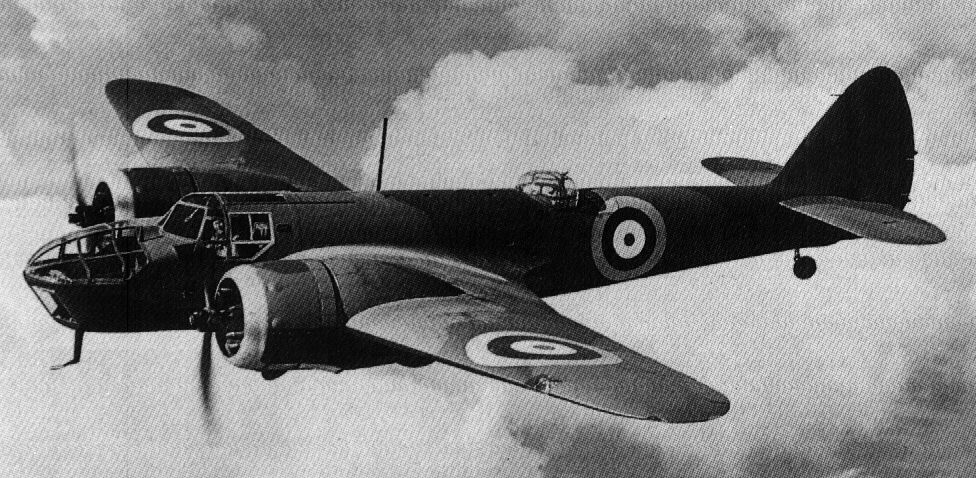
Bristol Blenheim
Updated: January 2008
Developed for a private-venture design the aircraft was intended to the enter Royal Air Force Service as a light bomber. The design appeared just as the realization that the RAF needed to be re-equipped with more modern aircraft to replace their obsolete Hart and Hind biplane bombers.
In August 1935, 150 aircraft were
ordered straight off of the drawing board. The first prototype (K7033) flying in
June 1936 just one year after the initial order had been placed. The Blenheim
Mk.I was soon out-performing all of the RAF's current fighters and development
was rapid. By March 1937, No. 114 Squadron, RAF stationed at
Wyton, became the first squadron to operate the new
type.
A total of 1134 Blenheim Mk. I's were built and despite the severe
limitations of the aircraft, which became clear as more modern fighter aircraft
began to appear. The Blenheim Mk. I was to prove a vital link in bringing the
RAF bomber forces to a position from where they could move forward into more
advance aircraft.
By the outbreak of World War II the Mk. I's had in the
mainly been replaced with the Mk. IV. This mark giving the crew a more
comfortable seating arrangement and by the addition of a scalloped nose; the
pilot gained improved visibility when landing and taxing the aircraft. The
overall performance of the aircraft however, was not significantly improved from
the earlier mark.
During the first two years of the war, Blenheim's had several modifications made to them, which included: extra armament and armour plate being added in an attempt to improve the survivability of the aircraft to fighter and flak damage. However, even with these modifications daylight operational losses still remained high. And with few options available to the Air Ministry; Blenheim equipped Squadron's were to shouldered the brunt of Bomber Command's daylight operations for the first two years of the war.
Blenheim IV Data
Crew: Three
Engines: Two 905 hp Bristol Mercury XV
Wing Span: 56'-6" (17.22m)
Length : 42'-7" (12.98m)
Height : 9'-10" (2.99m)
Empty Weight : 9,700 lbs. (4,400 kg)
Loaded Weight: 14,400 lbs. (6,532 kg)
Maximum Speed: 266 mph at 11,800 ft. (3,597 m)
Ceiling : 22,000 ft. (6,706 m)
Armament:
One fixed 0.303" machine gun, dorsal turret and under-nose blister each with two 0.303" machine guns.
Maximum bomb load, 1,000 lbs. (4,536 kg) internally, plus 320 lbs. (145 kg) mounted externally.
Bomber Command Squadrons Equipped With The Blenheim IV
15, 18, 21, 34, 35, 40, 44, 57, 61, 62, 82, 88, 90, 101, 104, 105, 107, 108, 110, 114, 139, 144, 218, 226
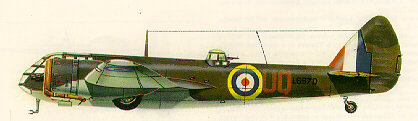
Blenheim Mk. I
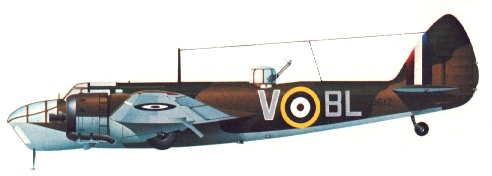
Blenheim Mk. IV